Google Block Breaker: How to Play, Tips, Levels, Power-Ups and FAQs

Introduction
Google Block Breaker is a simple arcade game with an easy goal: control a paddle, keep the ball in play, and break as many blocks as possible. The controls are simple enough for beginners, but the gameplay can become challenging when the ball moves faster and the block patterns become harder to clear.
The game follows the classic brick-breaker formula. A ball moves around the playing area and bounces from walls, blocks, and the paddle. Every successful hit can remove a block and bring you closer to clearing the level. Your main job is to position the paddle correctly before the ball reaches the bottom of the screen.
What makes this type of game enjoyable is the balance between quick reactions and smart positioning. You do not need complicated gaming skills to start. However, getting a high score requires practice, timing, prediction, and good control of the paddle.
There are also different versions of Block Breaker available online. Some browser versions include features such as multiple stages, lives, power-ups, level selection, and special blocks. Because these features can vary between websites, it is important not to assume that every version has exactly the same rules.
This complete guide explains Google Block Breaker, how the game works, how to control it on desktop and mobile, how lives and power-ups work, and which strategies can help you play better.
What Is Google Block Breaker?
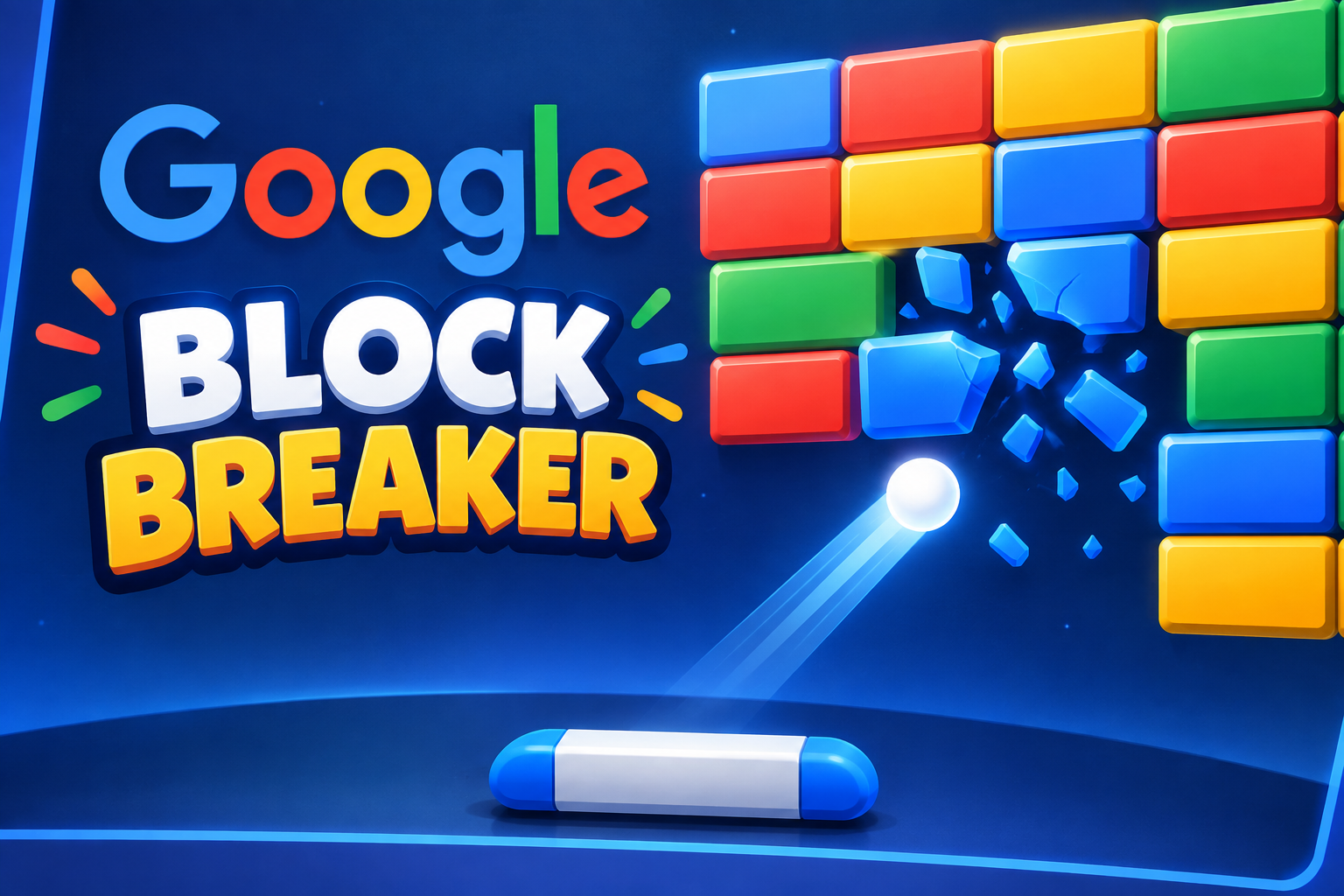
Google Block Breaker is an arcade-style brick-breaking game where players use a paddle to bounce a ball into blocks.
The basic objective is straightforward:
Keep the ball in play and destroy the blocks before you lose all your available lives.
The paddle is usually positioned near the bottom of the game area. The blocks appear above it. When the ball hits a block, the block may disappear or change depending on the game’s rules.
The ball then continues moving in another direction.
This creates a simple gameplay cycle:
- Start the game.
- Control the paddle.
- Bounce the ball.
- Break blocks.
- Avoid losing the ball.
- Clear the stage.
- Continue to the next challenge.
Some versions add extra features to make the experience more interesting. These can include additional balls, larger paddles, special attacks, bonus items, difficult block patterns, and progressive stages.
How Does Google Block Breaker Work?
The game is based on timing and movement.
When the ball is launched, it travels across the playing area. It can bounce from the side walls and the top of the screen. When it reaches the paddle, you need to position the paddle underneath it.
If the paddle catches the ball, the ball continues moving.
If you miss it, the ball falls below the paddle and you may lose a life.
The blocks are the main targets. Your objective is to destroy them while keeping the ball active.
The interesting part is that you are not simply controlling the ball. You are controlling the paddle and predicting where the ball will arrive.
That means successful gameplay depends on anticipation.
How to Play Google Block Breaker
Playing Google Block Breaker is easy once you understand the basic controls.
Start by opening the version of the game you want to play. Once the game loads, begin the round.
The ball will move around the playing area.
Watch its direction carefully.
Move the paddle left or right so it is underneath the ball when the ball comes back down.
After the ball hits the paddle, it will move upward again and continue breaking blocks.
The basic strategy is:
- Watch the ball.
- Predict its path.
- Move the paddle early.
- Keep the ball alive.
- Break blocks efficiently.
- Avoid unnecessary movement.
Do not worry about getting a huge score during your first attempt. Learning the movement of the ball is more important.
Google Block Breaker Controls
Controls can vary depending on the version you are playing.
Common controls include:
- Left arrow key
- Right arrow key
- Mouse movement
- Touch movement
- On-screen controls
On desktop computers, keyboard controls can give you quick and precise movement.
If the game supports mouse control, moving the mouse can also make paddle positioning easier.
On mobile devices, touch controls are usually more convenient.
Desktop Controls
Desktop players should focus on smooth paddle movement.
Use the left and right arrow keys to move the paddle.
Avoid holding a key for too long if the paddle moves quickly. A small movement may be enough to place the paddle directly under the ball.
The goal is not to move as much as possible.
The goal is to move only as much as necessary.
Mobile Controls
Mobile gameplay requires a slightly different approach.
Your finger may cover part of the screen while you move the paddle, so avoid making unnecessary movements.
Try to keep your finger movement smooth and predictable.
If the ball is moving toward the left, start moving the paddle in that direction early. Waiting until the last second can make the ball difficult to catch.
Understanding the Paddle
The paddle is your most important tool.
It protects you from losing the ball.
But it also influences the direction in which the ball travels.
A ball that hits the middle of the paddle may follow a relatively controlled path.
A ball that hits near one edge may move at a sharper angle.
Learning this difference can improve your gameplay significantly.
Why Paddle Position Matters
Imagine the ball is moving toward the right side of the screen.
If your paddle stays in the center, you may miss it.
Instead, move the paddle toward the expected landing point.
The earlier you position the paddle, the more time you have to make a small correction.
This is much better than waiting until the ball is almost at the bottom.
Understanding Ball Movement
At first, the ball may appear predictable.
As you continue playing, however, its movement can become harder to track.
The ball can:
- Bounce from side walls
- Hit the top of the screen
- Strike multiple blocks
- Change direction after hitting the paddle
- Move through gaps
- Become faster in difficult stages
Instead of reacting to every movement, learn to predict the ball’s next position.
This is one of the biggest differences between a beginner and an experienced player.
How Levels Work
The number and design of levels depend on the version of Block Breaker you are playing.
Some browser versions provide a large number of stages and progressively harder layouts. One popular version, for example, advertises 150 stages, along with features such as three lives and power-ups.
However, those features belong to that particular implementation and should not automatically be treated as universal features of every Google Block Breaker experience.
As levels become harder, you may encounter:
- More complicated block arrangements
- Faster gameplay
- Difficult angles
- Special blocks
- Limited opportunities for mistakes
- Additional gameplay mechanics
The important thing is to adapt your strategy instead of using the same movement in every level.
Lives and Game Over
Lives give you additional chances to continue playing after missing the ball.
If the ball falls below the paddle, one life may be lost.
Once all available lives are gone, the game ends.
The number of lives depends on the game version. Some versions use three lives as part of their standard gameplay.
Lives make defensive play important.
You do not need to destroy every block as quickly as possible.
Sometimes the smarter choice is to focus on keeping the ball alive.
How to Protect Your Lives
Follow these simple rules:
- Watch the ball instead of the blocks alone.
- Move the paddle early.
- Avoid sudden movements.
- Learn the ball’s direction.
- Do not panic when the speed increases.
- Use useful power-ups carefully.
- Focus on survival during difficult moments.
A player who survives longer gets more opportunities to score.
Power-Ups in Google Block Breaker
Power-ups can provide temporary advantages.
They may appear after destroying certain blocks, depending on the game version.
Different games use different power-up systems.
Common examples include:
Multi-Ball
A multi-ball power-up can introduce additional balls into the playing area.
This can help you destroy blocks faster.
However, it also creates a new challenge.
You now have more movement to watch.
Beginners sometimes become distracted by multiple balls and lose track of the paddle.
When this happens, focus on the ball that poses the most immediate threat to your paddle.
Larger Paddle
A larger paddle gives you more room to catch the ball.
This can be extremely useful when the ball is moving quickly.
If you receive a paddle-expansion power-up, use the extra space to improve your defensive position.
Special Attack
Some versions include special abilities that allow the paddle or another game element to attack blocks directly.
These abilities can speed up level completion.
Their usefulness depends on the current block layout and your position in the game.
Best Google Block Breaker Strategies
Good gameplay is not only about fast reactions.
Strategy matters.
Here are some practical techniques that can help you improve.
1. Watch the Ball First
The most important rule is simple:
Never lose track of the ball.
It can be tempting to watch the blocks because they are your targets.
But the ball determines whether you survive.
Make the ball your primary focus.
2. Move the Paddle Early
Do not wait until the ball is directly above the paddle.
Estimate where it will land.
Then move the paddle toward that position.
Early movement gives you more time to correct your position.
3. Avoid Random Movement
Moving the paddle from one side to another without a plan can make the game harder.
Controlled movement is better.
If the ball is traveling toward the right, move right.
Once the paddle reaches the correct position, stop or make small corrections.
4. Learn Paddle Angles
The position where the ball touches the paddle can influence its next direction.
Use this to your advantage.
If you want the ball to travel toward a particular side, try adjusting where it contacts the paddle.
With practice, this becomes a natural part of gameplay.
5. Look for Openings
Some block layouts contain gaps.
These gaps can allow the ball to travel deeper into the block formation.
Instead of immediately changing the ball’s direction, sometimes it is better to allow it to continue through the opening.
A good angle can let one ball destroy several blocks before returning toward the paddle.
6. Do Not Rush
Speed is not always an advantage.
If you rush your paddle movement, you may overcorrect.
Stay calm.
Watch the ball.
Make small adjustments.
7. Use Power-Ups at the Right Time
A power-up can be useful, but timing matters.
For example, a multi-ball effect can be excellent when many blocks remain.
A larger paddle can be more valuable when the ball becomes difficult to catch.
Think about the current situation before chasing a bonus.
How to Get a Higher Score
Getting a high score requires consistency.
You need to survive while clearing blocks efficiently.
Keep the Ball Active
Every second that the ball remains in play creates another opportunity to break blocks.
Avoid risky movements that could end the round.
Break Groups of Blocks
When blocks are close together, try to create angles that allow the ball to move through the group.
One well-placed rebound can sometimes clear several blocks.
Target Difficult Blocks
Some blocks may be harder to reach.
Instead of repeatedly hitting easy targets, look for a path that gives the ball access to the difficult areas.
Protect Your Advantage
If you have a useful power-up or a favorable ball position, do not become careless.
The final part of a level can sometimes be more difficult than the beginning because fewer blocks remain and the ball may move unpredictably.
Beginner Mistakes to Avoid
Moving Too Late
This is one of the most common mistakes.
If you wait until the ball is almost at the bottom, there may not be enough time to reach it.
Move early.
Moving Too Much
Overcorrection can be just as bad as moving too late.
Small movements are often enough.
Watching the Blocks Instead of the Ball
Your goal is to break blocks, but your immediate responsibility is to keep the ball alive.
Always prioritize the ball.
Ignoring Angles
If you do not pay attention to where the ball hits the paddle, you lose an opportunity to influence its direction.
Panicking When the Ball Speeds Up
Fast gameplay requires controlled reactions.
Do not make large movements simply because the ball looks faster.
Advanced Google Block Breaker Tips
Once you understand the basics, you can start using more advanced techniques.
Predict the Landing Point
Instead of simply following the ball, estimate where its path will meet the paddle.
This allows you to move earlier.
Use Wall Rebounds
The side walls can become useful parts of your strategy.
A wall bounce may send the ball toward a difficult block area.
Learn how the ball behaves after different rebounds.
Create Better Angles
Try to control the paddle contact point.
The goal is not just to catch the ball.
The goal is to send it somewhere useful.
Prioritize Survival
High-level play often depends on avoiding unnecessary risks.
A risky shot may destroy several blocks, but losing a life can cost you much more.
Consistency usually beats reckless play.
Google Block Breaker on Mobile
Mobile gaming makes Block Breaker convenient because you can play from almost anywhere.
Touch controls are generally easy to understand.
However, smaller screens can make fast gameplay more difficult.
For better mobile performance:
- Keep your device steady.
- Use smooth finger movements.
- Avoid covering the ball with your finger.
- Keep your eyes on the lower part of the screen when the ball approaches.
- Reduce unnecessary movement.
- Practice with slower stages first.
If the browser version is responsive, it should adapt to the mobile screen automatically.
Google Block Breaker on Desktop
Desktop computers can provide more precise control.
A larger display makes it easier to follow the ball.
Keyboard controls can also feel more responsive.
For desktop play:
- Keep your hands near the movement keys.
- Avoid holding keys unnecessarily.
- Watch the ball’s trajectory.
- Use small corrections.
- Keep the playing area visible.
A larger monitor can be particularly useful when multiple balls are active.
Google Block Breaker vs. Classic Breakout
Google Block Breaker is closely related to the classic Breakout style of gameplay.
Both use the same basic concept:
| Feature | Block Breaker | Classic Breakout |
| Paddle | Yes | Yes |
| Ball | Yes | Yes |
| Blocks | Yes | Yes |
| Main goal | Break blocks | Break blocks |
| Lives | Version-dependent | Common |
| Power-ups | Some versions | Depends on version |
| Modern browser versions | Common | Less common |
| Mobile support | Often available | Version-dependent |
The main difference is that modern Block Breaker versions can add features that were not part of the original simple formula.
These can include multiple balls, power-ups, stage selection, modern graphics, special blocks, and different control systems.
Is Google Block Breaker Free?
Many online Block Breaker versions can be played for free through a web browser.
You should still check the specific website you are using because different sites can have different advertising, controls, features, or access requirements.
If a website asks you to download an unknown file before playing a simple browser game, be careful.
A browser game should not normally require unnecessary software just to start a basic arcade experience.
Can You Play Google Block Breaker Without Downloading?
Yes, browser-based versions can be played without installing a separate game application.
This is one of the main advantages of online arcade games.
You can open the game in a compatible browser and start playing.
The exact availability can depend on the version, website, device, and region.
Is Google Block Breaker Available on Mobile?
Many browser versions are designed to work on mobile devices.
The exact experience depends on whether the game supports touch controls and responsive layouts.
If the controls feel difficult, try using a larger screen or desktop version.
Is Google Block Breaker the Same as Google Atari Breakout?
Not necessarily.
The names are sometimes used together because both experiences are based on the classic brick-breaking concept.
Google’s older Atari Breakout Easter egg became well known because it transformed image-search results into a Breakout-style game.
Modern Block Breaker pages can use a different design and different gameplay mechanics.
Therefore, it is better to treat them as related arcade experiences rather than automatically assuming they are the exact same game.
Pros and Cons of Google Block Breaker
| Pros | Cons |
| Easy to learn | Can become difficult quickly |
| Simple controls | Requires concentration |
| Quick gameplay sessions | Mistakes can cost lives |
| No complex rules | Different versions may vary |
| Suitable for beginners | Fast balls require practice |
| Works well as a casual game | Some sites may contain ads |
| Classic arcade feel | Advanced stages can be challenging |
Why Is Google Block Breaker So Addictive?
The game has a very short learning curve.
You understand the basic objective almost immediately.
But becoming good at it takes longer.
That combination creates a strong gameplay loop.
You start a round.
You break a few blocks.
You make a mistake.
You lose a life.
Then you want to try again.
The game also provides constant visual feedback. Every successful hit changes the playing field, so the player can see progress immediately.
This makes the experience satisfying without requiring complicated mechanics.
Is Google Block Breaker Good for Beginners?
Yes.
The basic controls are simple.
A new player can understand the main objective within a few seconds.
The difficulty comes later.
Beginners should focus on learning three things:
- How the paddle moves.
- How the ball changes direction.
- How to predict where the ball will land.
Once these skills improve, the rest of the game becomes easier.
How Long Does It Take to Get Good at Block Breaker?
There is no fixed amount of time.
Some players may understand the controls within a few rounds.
Becoming consistently good takes more practice.
The most useful practice is not simply playing repeatedly.
Pay attention to your mistakes.
Ask yourself:
- Did I move too late?
- Did I move too far?
- Did I ignore the ball?
- Did I choose the wrong angle?
- Did I take an unnecessary risk?
Learning from each mistake is faster than repeating the same mistake.
Common Myths About Google Block Breaker
Myth 1: You Need Extremely Fast Reflexes
Fast reactions help, but prediction is often more important.
If you can estimate where the ball will land, you do not need to make a last-second movement.
Myth 2: The Fastest Strategy Is Always the Best
Not necessarily.
Fast block clearing can be useful, but losing a life can undo your progress.
Balanced gameplay is often better.
Myth 3: Every Block Breaker Website Is the Same
This is incorrect.
Different websites can use different levels, controls, power-ups, scoring systems, and layouts.
Always check the specific version you are playing.
Quick Strategy Guide
| Situation | Recommended Strategy |
| Ball moving slowly | Plan your next paddle position |
| Ball moving quickly | Move early and use small corrections |
| Many blocks remain | Look for useful openings |
| Few blocks remain | Focus on survival |
| Multiple balls active | Watch the balls closest to the paddle |
| Large paddle power-up | Use the extra width defensively |
| Difficult corner blocks | Use wall and paddle angles |
| Low remaining lives | Avoid risky shots |
Google Block Breaker Checklist for New Players
Before starting a serious attempt, remember these points:
- Understand your controls.
- Watch the ball.
- Move early.
- Keep the paddle controlled.
- Learn the bounce angles.
- Protect your lives.
- Use power-ups wisely.
- Avoid unnecessary risks.
- Practice difficult sections.
- Focus on consistency.
These simple habits can make a noticeable difference.
Frequently Asked Questions
What is Google Block Breaker?
Google Block Breaker is a brick-breaking arcade game in which players control a paddle and bounce a ball into blocks. The objective is to destroy the blocks while keeping the ball in play.
How do you play Google Block Breaker?
Control the paddle from left to right and position it under the ball. Keep the ball from falling below the paddle while using its rebounds to destroy the blocks.
Is Google Block Breaker free to play?
Many browser-based versions are free to play. However, features and access can vary depending on the specific version or website.
Can I play Google Block Breaker on my phone?
Yes, many online versions support mobile devices. Touch controls may be available depending on the version.
Do I need to download Google Block Breaker?
A browser-based Block Breaker game generally does not require a separate download. You can play directly through a compatible browser when the game is available.
How many levels does Google Block Breaker have?
There is no single level count that applies to every version. Some third-party Block Breaker games advertise specific stage counts, while other versions use different progression systems.
How many lives do you get in Block Breaker?
The number of lives depends on the version. Some versions use three lives, while other implementations may use different rules.
What are Block Breaker power-ups?
Power-ups are special bonuses that can provide gameplay advantages. Depending on the version, they may increase paddle size, create multiple balls, or provide another temporary ability.
How can I get better at Google Block Breaker?
Practice paddle control, learn how the ball changes direction, predict its landing position, and avoid unnecessary movements. Good timing and patience are more useful than random fast reactions.
Is Google Block Breaker the same as Atari Breakout?
They are related because both use the classic paddle-and-ball brick-breaking concept, but they should not automatically be considered the same game. Different Google and third-party experiences can use different designs and mechanics.
What is the best strategy for Block Breaker?
The best general strategy is to prioritize survival, move the paddle early, learn useful angles, and take advantage of openings in the block layout. Power-ups should be used according to the situation rather than collected without a plan.
Why do I keep losing the ball?
The most common reasons are late paddle movement, overcorrection, and failing to predict the ball’s landing position. Watch the trajectory and position your paddle before the ball reaches the bottom.
Final Thoughts
Google Block Breaker is a simple arcade game that rewards both quick reactions and careful strategy. The basic objective is easy: control the paddle, bounce the ball, and break the blocks. The challenge comes from doing it consistently as the gameplay becomes faster and more demanding.
If you are a beginner, do not focus on achieving a huge score immediately. Start by learning the controls. Then practice predicting the ball’s landing point. Once your paddle movement becomes natural, begin experimenting with angles, wall rebounds, power-ups, and more advanced strategies.
It is also important to remember that the name Google Block Breaker can refer to different online experiences. Features such as stage counts, lives, power-ups, and controls may differ between versions.
The best way to improve is simple: play carefully, learn from every mistake, and focus on keeping the ball alive.
With enough practice, you will move from simply reacting to the ball to predicting its path—and that is where the game becomes much more interesting.