Google Block Breaker: How to Play, Controls, Tips & Strategies

Introduction
If you enjoy simple arcade games that are easy to start but difficult to master, Google Block Breaker is worth trying. The game follows a classic brick-breaking concept: control a paddle, bounce a ball around the screen, destroy blocks, and try not to let the ball fall.
The basic idea is simple, but the gameplay becomes more challenging as the ball moves faster and the block arrangement becomes harder to clear. Good results depend on timing, concentration, paddle control, and understanding the ball’s direction.
Different websites may offer their own versions of the game, so the exact number of levels, controls, power-ups, and lives can vary. However, the central gameplay remains similar across most browser-based block-breaker games.
This guide explains what Google Block Breaker is, how to play it, which controls you may need, how power-ups work, and which strategies can help beginners improve their performance.
What Is Google Block Breaker?
Google Block Breaker is a browser-based arcade game based on the traditional brick-breaker format.
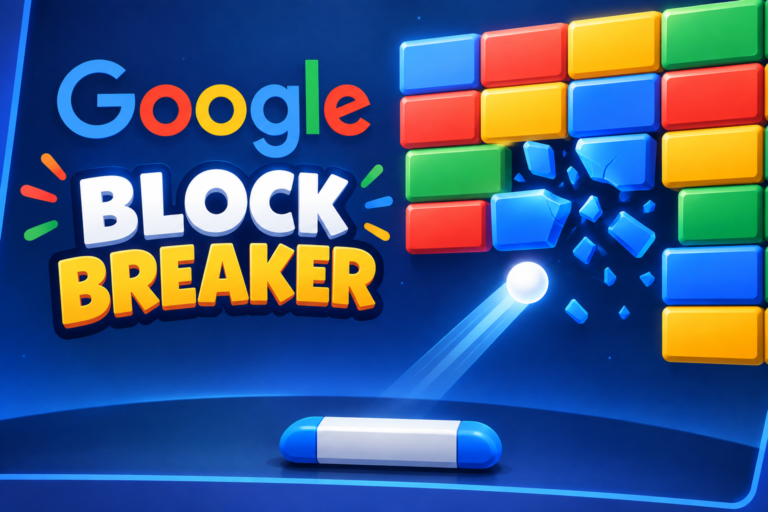
The player controls a horizontal paddle at the bottom of the game area. A ball moves around the screen and hits blocks positioned above. Every successful collision can remove or damage a block.
The player’s main responsibility is to keep the ball in play.
If the ball passes the paddle and reaches the bottom of the game area, the player may lose a life or an attempt. The exact life system depends on the version being played.
The game combines several simple elements:
- A moving ball
- A player-controlled paddle
- Breakable blocks
- Walls or boundaries
- Different levels or stages
- Possible power-ups
- Lives or attempts
- Score or progress
Although the concept is simple, the game requires increasingly accurate reactions as the difficulty rises.
How Does Google Block Breaker Work?
The gameplay is based on a straightforward cycle.
The ball moves around the playing area and bounces whenever it hits an appropriate surface. When it reaches the paddle, the paddle’s position affects the direction in which the ball travels next.
Your objective is to keep returning the ball while allowing it to hit as many blocks as possible.
A typical round follows this pattern:
- Start the game.
- Launch the ball.
- Watch its movement.
- Move the paddle underneath it.
- Bounce the ball back upward.
- Destroy blocks.
- Collect useful bonuses when possible.
- Continue until the level is cleared or you lose the available lives.
The challenge comes from predicting where the ball will reach the bottom of the screen.
How to Play Google Block Breaker
Playing the game is usually straightforward because you do not need complicated controls.
Start the Game
Open the version you want to play and select its play or start option.
Depending on the website, the ball may begin automatically or require a keyboard key, click, or tap to launch.
Control the Paddle
Move the paddle horizontally so that it stays underneath the ball.
On desktop devices, arrow keys are commonly used. Some versions may provide alternative controls.
On mobile devices, touch or swipe controls may be available.
Break the Blocks
After launching, the ball travels toward the block formation.
When it hits a block, that block may disappear or require additional hits, depending on the game version.
Your goal is to clear the required blocks while keeping the ball from reaching the bottom.
Continue Through the Level
Once the necessary blocks have been destroyed, you may move to another level.
Some versions contain a large number of stages, while others use shorter level structures.
This variation is one reason it is important to check the instructions provided by the particular game website.
Google Block Breaker Controls
Controls are not identical across every version, but common controls include the following:
| Action | Common Control |
|---|---|
| Move left | Left Arrow |
| Move right | Right Arrow |
| Launch ball | Spacebar or Up Arrow |
| Start game | Play button |
| Restart | Restart or Play Again |
| Mobile movement | Touch, drag, or swipe |
Before starting a serious game, check the control instructions on the page you are using.
Desktop Controls
Playing on a computer can make paddle movement easier because keyboard controls allow quick horizontal adjustments.
Use controlled movements rather than pressing keys randomly.
If the ball is approaching from the left, move toward its expected landing position. If it changes direction, adjust the paddle accordingly.
Mobile Controls
Mobile gameplay can be convenient because you can play directly from a phone or tablet.
However, the smaller display can make fast-moving balls harder to follow.
Keep your movements controlled and avoid moving the paddle farther than necessary.
Understanding the Paddle
The paddle is your most important tool.
Many beginners think of it only as a way to stop the ball. In reality, the paddle can also influence the ball’s direction.
Imagine the paddle as three areas:
- Left section
- Center section
- Right section
The point where the ball contacts the paddle can affect its next movement.
A central hit is usually easier to predict. A hit closer to an edge can produce a more angled trajectory.
Once you understand this, you can begin using the paddle to guide the ball rather than simply reacting to it.
Why Paddle Position Matters
Suppose the ball is moving toward the right side.
If you wait until the final moment before moving, you have very little time to react.
Instead, estimate where the ball is going and position the paddle before it arrives.
This simple habit can make your gameplay much more consistent.
Understanding the Ball’s Movement
The ball is constantly changing direction after hitting blocks, walls, or the paddle.
That means you should focus on its trajectory rather than its current position alone.
Ask yourself:
Where will the ball be when it reaches the paddle?
That is a more useful question than:
Where is the ball right now?
This difference is especially important when the ball starts moving quickly.
Lives and Game Over
Many block-breaker games use a limited number of lives.
A life is generally lost when the ball passes the paddle.
Some versions may provide extra opportunities through bonuses or level mechanics.
When all available lives are used, the current game ends.
The exact system varies between versions, so do not assume that every Google Block Breaker-style game uses the same number of lives.
How to Protect Your Lives
The safest approach is to prioritize the ball.
Do not take unnecessary risks simply to collect a bonus.
For example, if a power-up is falling on the opposite side of the screen while the ball is approaching your paddle, protecting the ball should usually come first.
Power-Ups in Google Block Breaker
Power-ups can make the gameplay more interesting by temporarily changing how the paddle, ball, or blocks behave.
The available power-ups differ between versions.
Common types in block-breaker games can include:
- Wider paddle
- Multiple balls
- Faster or slower ball
- Additional life
- Special block-breaking effects
Wider Paddle
A wider paddle increases the area available for catching the ball.
This can be especially useful when the ball is moving quickly.
Multi-Ball
A multi-ball bonus creates additional balls on the screen.
This can help clear blocks more quickly because several balls are active at once.
However, more balls also mean more movement to track.
Do not panic when multiple balls appear. Focus first on the ball that poses the greatest immediate danger to your paddle.
Extra Life
An extra-life bonus can be extremely useful.
If you have the opportunity to collect one safely, it can give you another chance to continue the game after making a mistake.
Best Google Block Breaker Strategies
Good gameplay is not only about fast reactions.
The strongest players combine reaction with prediction.
1. Predict the Landing Position
Do not wait for the ball to reach the bottom.
Watch its direction and estimate where it will arrive.
Move the paddle toward that position before the ball gets there.
2. Avoid Unnecessary Movement
Moving the paddle continuously can actually make the game harder.
Too much movement can cause you to overshoot the ball.
Make small adjustments whenever possible.
3. Use Angles to Reach Difficult Blocks
Sometimes blocks remain in areas that are difficult to reach with a straight shot.
Use the paddle to change the ball’s angle.
A controlled angled shot can send the ball into areas that would otherwise remain untouched.
4. Look for Openings
When a section of blocks begins to disappear, openings can appear.
Try to send the ball through those openings.
Once the ball enters an area behind the main block formation, it may hit several blocks before returning downward.
5. Do Not Chase Every Power-Up
Power-ups are helpful, but they are not always worth the risk.
If collecting a bonus would put the ball in danger, ignore the bonus.
The goal is to keep playing, not to collect every falling item.
6. Stay Calm at Higher Speeds
Fast balls can cause beginners to panic.
The natural reaction is to move the paddle quickly from side to side.
That often creates mistakes.
Instead, reduce unnecessary movement and concentrate on predicting the ball’s path.
Beginner Tips for Google Block Breaker
If you are new to the game, these simple habits can help.
Keep the Paddle Ready
Do not leave the paddle at an extreme side of the screen unless you have a reason.
Keeping it closer to a central position gives you more room to react.
Watch the Ball Continuously
Avoid looking away from the ball for too long.
The game can change quickly after a collision.
Learn From Missed Shots
Every missed ball can teach you something.
Think about what happened:
- Did you react too late?
- Did you move too far?
- Did the ball change direction?
- Were you distracted by a power-up?
- Was the paddle in the wrong position?
Identifying the problem can help you avoid repeating it.
Practice Before Chasing High Scores
Do not worry about achieving a huge score immediately.
First learn the movement patterns and controls.
Once you become comfortable, better scores will naturally become easier.
Advanced Google Block Breaker Techniques
Once you understand the basics, you can start using more deliberate strategies.
Control the Ball’s Angle
The paddle can be used to influence the ball’s trajectory.
Instead of allowing every shot to return at the same angle, try to direct the ball toward areas that still contain many blocks.
Create a Path Behind the Blocks
One of the most useful situations occurs when the ball gets behind the main block formation.
The ball can then bounce between the upper boundary and remaining blocks, potentially clearing several targets before returning to the paddle.
Creating such an opening can be more valuable than simply destroying the nearest block.
Prioritize Difficult Areas
Some blocks are easier to reach than others.
If one area is particularly difficult, look for a suitable angle that allows the ball to enter it.
Think Beyond the Next Bounce
Beginners usually focus on the immediate bounce.
More experienced players can start thinking about what happens after that bounce.
For example:
Paddle → wall → block → block → paddle
Thinking about several collisions ahead can improve decision-making.
Common Mistakes to Avoid
Moving the Paddle Too Much
Constant movement does not mean better control.
Move only when needed.
Waiting Until the Last Second
Late reactions leave you with very little room for correction.
Start moving as soon as you understand the ball’s direction.
Focusing Too Much on Bonuses
A power-up is not useful if you lose a life while trying to collect it.
Protect the ball first.
Ignoring Ball Angles
If you always return the ball from the center of the paddle, your shots may become predictable.
Learning how different contact points affect direction gives you greater control.
Panicking During Fast Gameplay
Fast movement requires precision, not random reactions.
Keep your eyes on the ball and make smaller paddle adjustments.
Google Block Breaker on Desktop vs Mobile
The best device depends on your personal preference and the controls offered by the specific version.
| Feature | Desktop | Mobile |
|---|---|---|
| Screen size | Usually larger | Usually smaller |
| Controls | Keyboard or mouse | Touch |
| Precision | Often easier | Depends on touch response |
| Portability | Lower | High |
| Quick sessions | Good | Excellent |
Desktop Gaming
A larger screen can make the ball easier to track.
Keyboard controls can also provide predictable movement.
This can be useful for players who want more precise control.
Mobile Gaming
Mobile devices are convenient for short gaming sessions.
Touch controls can feel natural once you get used to them.
However, smaller screens may require more concentration when the ball becomes fast.
Is Google Block Breaker Free to Play?
Many browser-based versions of block-breaker games are available to play for free.
However, different websites can have different features, advertisements, rules, or gameplay systems.
Always check the individual game page before assuming that every version works in exactly the same way.
Can You Play Google Block Breaker Without Installing Anything?
Browser-based versions generally do not require a traditional software installation.
You can open the supported game page in a compatible browser and start playing.
Whether a particular game works without an internet connection depends on how that website delivers its game files.
Therefore, it is safer to consider Google Block Breaker an online browser gaming experience unless the specific version clearly states otherwise.
Is Google Block Breaker Available on Mobile?
Many browser versions can be played on mobile devices when they support responsive layouts and touch controls.
The experience may vary depending on the website and browser.
For the best experience, use a modern browser, keep the game area visible, and avoid unnecessary touch movements.
Google Block Breaker vs Traditional Breakout
Google Block Breaker-style games share their basic concept with classic brick-breaking titles such as Breakout.
| Feature | Google Block Breaker | Traditional Breakout |
|---|---|---|
| Paddle | Yes | Yes |
| Ball | Yes | Yes |
| Blocks | Yes | Yes |
| Levels | Version dependent | Usually available |
| Power-ups | Version dependent | Version dependent |
| Browser play | Common | Depends on version |
| Mobile support | Version dependent | Depends on version |
The main difference is often the presentation and additional gameplay features.
Modern browser versions may introduce new layouts, bonuses, multiple balls, different stages, and updated visual designs while keeping the classic mechanic.
Pros and Cons
Pros
- Simple controls
- Easy to understand
- Quick to start
- Suitable for short gaming sessions
- Requires concentration and timing
- Browser-based versions can be convenient
- Can become challenging with progression
Cons
- Features vary between websites
- Controls may differ
- Power-ups are not universal
- Fast gameplay can be difficult for beginners
- Online versions may depend on browser compatibility
Tips for Getting a Higher Score
If your goal is to improve your score, focus on consistency rather than taking unnecessary risks.
Protect Long Runs
A long run gives you more time to destroy blocks.
Avoid risky movements when the ball is moving quickly.
Use Power-Ups Intelligently
Do not automatically collect every bonus.
Choose bonuses that improve your current situation.
Clear Crowded Areas
When many blocks are grouped together, creating an opening can allow the ball to reach multiple targets.
Maintain Paddle Awareness
Even while watching the upper part of the screen, remember where your paddle is positioned.
You should be prepared before the ball begins its return journey.
Frequently Asked Questions
What is Google Block Breaker?
Google Block Breaker is a browser-based arcade game based on the classic brick-breaking concept. Players control a paddle, bounce a ball, destroy blocks, and try to progress through the game without losing their available lives.
How do you play Google Block Breaker?
Move the paddle horizontally to keep the ball from reaching the bottom of the screen. The ball breaks or damages blocks when it hits them. Continue playing until the level is cleared or your available lives are exhausted.
What are the controls for Google Block Breaker?
Controls depend on the version. Common controls include the left and right arrow keys for paddle movement and the Spacebar or Up Arrow for launching the ball.
Can I play Google Block Breaker on my phone?
Yes, browser versions that support mobile and touch controls can be played on phones and tablets. The exact experience depends on the website.
Is Google Block Breaker free?
Many online versions are free to play. However, individual websites can use different features and conditions, so check the specific game page you are using.
What do power-ups do?
Power-ups can provide temporary advantages such as a larger paddle, additional balls, extra lives, or other gameplay effects. Their exact functions vary by version.
How can I improve at Google Block Breaker?
Focus on predicting where the ball will land, make controlled paddle movements, learn how angles work, and avoid taking unnecessary risks for power-ups.
Why does the game become harder?
As gameplay progresses, the ball may move faster, block arrangements may become more difficult, and additional gameplay mechanics may be introduced. These changes require faster reactions and better positioning.
Is Google Block Breaker the same as Breakout?
They use the same basic paddle-and-ball concept, but they are not necessarily the exact same game. Different Google Block Breaker versions can have their own levels, designs, controls, and features.
What is the best strategy for beginners?
The best starting strategy is to concentrate on keeping the ball alive. Learn to predict its landing position, use small paddle movements, and only chase bonuses when doing so is safe.
Conclusion
Google Block Breaker combines a very simple idea with gameplay that can become surprisingly challenging. You control a paddle, bounce a ball, destroy blocks, and attempt to keep the ball in play for as long as possible.
The key to improving is not simply reacting faster. Good players learn to predict the ball’s movement, position the paddle early, control angles, and avoid unnecessary risks.
Power-ups can provide useful advantages, but they should not distract you from the main objective. Keeping the ball alive should normally be your first priority.
Different websites can provide different versions of the game, so controls, lives, levels, and special features may not always be identical. Always check the instructions for the specific version you are playing.
Whether you want a quick browser game or a more challenging arcade experience, Google Block Breaker offers a familiar gameplay style that is easy to learn and rewarding to improve at.